
BEST Bus Mumbai 2026: Routes, Electric Fleet & 100 Year History
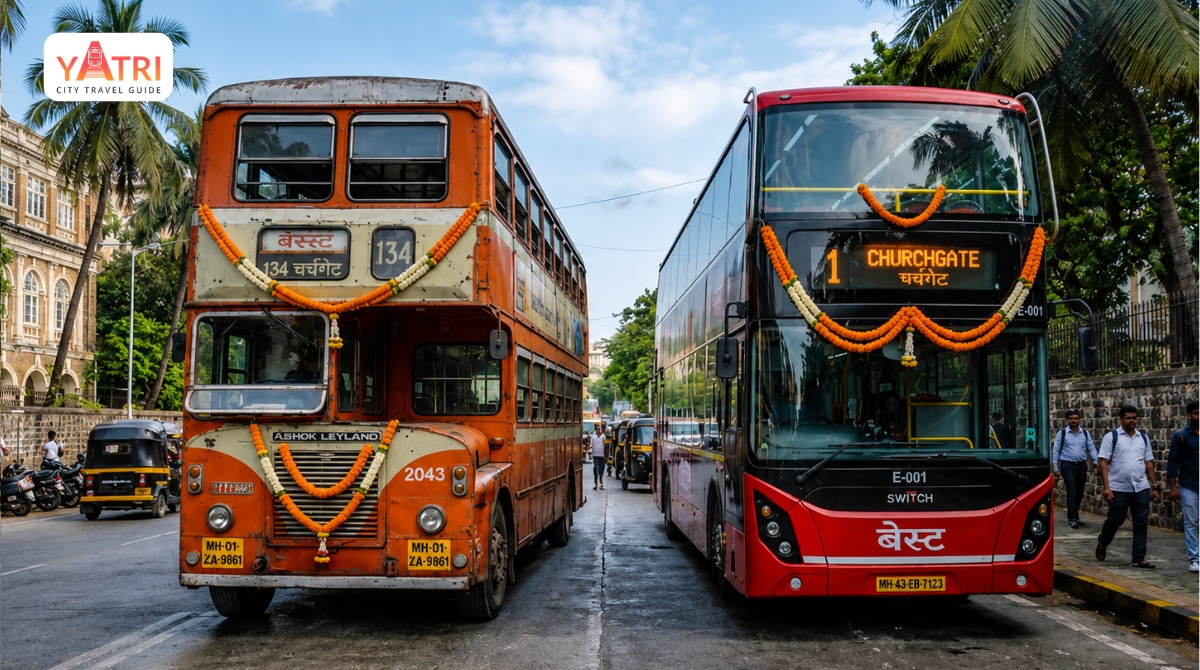
From 24 buses on 3 routes in 1926 to 20 lakh daily commuters in 2026 the complete story of Mumbai's oldest and most essential public transport service.
15th of July, the BEST bus Mumbai turns 100 years old and if you checked BEST bus timing this morning, tracked your Mumbai bus on an app, or rode one of the new electric bus Mumbai services rolling out across the city, you were part of a public transport story that has been running without stopping for an entire century. BEST bus routes today cover 160+ corridors and 1,701 bus stops, connecting every corner of Mumbai that local trains and the Metro do not directly reach.
That is not a routine anniversary. A hundred years of daily bus service in one of the world's most demanding cities through monsoons that flood every road, through strikes that test every system, through the renaming of the city itself from Bombay to Mumbai is the kind of infrastructure achievement that deserves more than a passing mention.
This is the complete story of the BEST bus in Mumbai: where it started, how it grew, what it looks like in 2026, and why it still matters more than most Mumbaikars realise on a regular Tuesday morning.
|
BEST Bus Mumbai Quick Facts 2026 |
|
|
Total Routes |
160+ |
|
Bus Stops |
1,701 |
|
Daily Passengers |
20 lakh (2 million) |
|
Electric Buses |
700+ operational, 8,000 target by 2027 |
|
Ticketing |
Tap-in Tap-out digital (cashless) |
|
Coverage |
Mumbai, Navi Mumbai, Thane, Mira-Bhayandar |
|
Founded |
July 15, 1926 (100 years old in 2026) |
|
BEST Bus Routes and Stops |
Available on Yatri app |
BEST Bus Mumbai: What It Is, How It Works & Why It Matters in 2026.
BEST stands for Brihanmumbai Electric Supply and Transport. But that name is the most recent version of an organisation that has been evolving since 1873 when it was first established as the Bombay Tramway Company Limited. Here is the full timeline of what BEST has been called across its 150-year history:
1. 1873: Bombay Tramway Company Limited (horse-drawn trams, first public transport in Bombay)
2. 1905: Bombay Electric Supply and Tramways Company, or B.E.S.T. (introduced electric trams, began supplying electricity to the city)
3. 1947: Bombay Electric Supply and Transport (became a municipal undertaking under the BMC on August 7, 1947 exactly one week before Indian Independence)
4. 1995: Brihanmumbai Electric Supply and Transport, or BEST (renamed when Bombay became Mumbai)
Today BEST operates as an autonomous body under the Brihanmumbai Municipal Corporation (BMC), covering bus transport and electricity supply across Mumbai.
Fun Fact: BEST was supplying electricity to Bombay from 1905 before it ever ran a single motor bus. Mumbai's buses and Mumbai's power grid have the same parent organisation. Few Mumbaikars know this.
When Did the First BEST Bus Start in Mumbai? The 1926 Origin Story.
The story of the first BEST bus in Mumbai actually begins 13 years before it launched.
In 1913, the Mumbai Municipality debated whether to introduce trolley buses or motor buses to supplement the expanding tram network. The decision kept getting delayed because of a high accident rate involving a similar motorbus service running in London at the time. Mumbai was being cautious which, given the city's current traffic, seems both admirable and ironic.
On February 10, 1926, the B.E.S.T. Company finally made the decision official: three routes would be introduced on an experimental basis. And on July 15, 1926 exactly 100 years ago today 24 single-deck motor buses began operating simultaneously across three routes:
The 3 Original BEST Bus Routes (July 15, 1926): Route 1: Afghan Church (Colaba) to Crawford Market. Route 2: Dadar Tram Terminus to King's Circle via Parsi Colony. Route 3: Opera House to Lalbaug via Lamington Road and Arthur Road.
The buses ran at a cruising speed of 32 km/hr. Each bus could seat 24 passengers with 2 standing. The fare was affordable by design the goal was mass commuter access, not profit.
Taxi drivers and horse-drawn carriage operators protested loudly. They saw, correctly, that cheap and reliable motorbus service would pull passengers away from their business. But Bombay's commuters had already made their choice. The buses ran without a hitch on Day 1.
1926 Passenger Numbers: 6 lakh (600,000) passengers by December 31, 1926. 38 lakh (3.8 million) passengers by end of 1927. The city had found its mode of transport.
In its first year, the BEST bus carried 6 lakh passengers despite protests, uncertainty, and the complete novelty of motorised public transport in Bombay. By the second year: 38 lakh. The city didn't debate it. It just got on the bus.
BEST Bus History Mumbai: 100 Years Decade by Decade
1. BEST Bus First Decade in Mumbai: 1926 - 1940:
After the successful 1926 launch, BEST expanded carefully but consistently. In March 1930, concessional fares were introduced on short journeys which immediately pulled in more passengers including, notably, car owners who found the cheap fares more convenient than parking. By 1934, BEST had extended its routes to the northern parts of the city in response to requests from the government and BMC.
In 1935, BEST ran an experimental 'whole-day ticket' during Christmas holidays allowing unlimited travel across the city on a single ticket. This is believed to be one of the first unlimited day-pass experiments in Indian public transport history.
By 1940, BEST had introduced India's first limited bus service (an express service running between Colaba and Mahim), making it a pioneer in differentiated urban bus services long before the concept became standard.
Fun Fact: In January 1927 just six months after the bus service launched BEST started hiring out buses for private use. Mumbai's bus charter industry is as old as Mumbai's bus service itself.
2. Mumbai's Iconic Double-Decker BEST Bus Era: 1937 - 1964:
By 1937, Mumbai's growing population had outpaced what single-deck buses could carry. BEST introduced double-decker buses that year capable of carrying 58 passengers compared to the 36-passenger single-deckers. Double-deckers quickly became not just the practical solution to overcrowding but one of Mumbai's most recognizable visual symbols.
When Mumbai Municipality took over the B.E.S.T. Company in 1947, double-decker buses constituted 65 to 70 per cent of the entire fleet. The red double-decker was already Mumbai's bus.
In 1964, the last tram route in Mumbai was closed permanently and the tram and bus workshops were merged under BEST. An era ended. But the bus network that replaced the trams went on to carry more passengers than the entire Mumbai railway system combined during its peak years.
Fun Fact: At the height of BEST's double-decker dominance, the undertaking was carrying more passengers daily than both Central Railway and Western Railway combined. This single fact is almost entirely forgotten in 2026.
3. BEST Bus Goes Electric: 1995 - 2022:
When Bombay officially became Mumbai in 1995, BEST renamed itself accordingly. But the deeper changes came in the decades that followed. Diesel buses gave way to CNG (Compressed Natural Gas) buses as part of Mumbai's anti-pollution push. Air-conditioned buses were introduced for premium commuters. GPS systems were installed on all buses, feeding real-time location data to management and passengers.
Then, in April 2022, BEST introduced its Tap-in Tap-out digital ticketing system making Mumbai the first city in India to operate fully digital buses where every transaction is cashless. Passengers board from the front, tap their Chalo smartcard or UPI-linked mobile, and tap out at the rear when exiting. No conductor. No paper ticket. No change problems.
And in February 2023, BEST inaugurated India's first electric AC double-decker bus an imported Switch EiV22 model, manufactured by a company that also builds electric buses for London. The route: CSMT to NCPA. Mumbai's first motorbus route in 1926 was also South Mumbai. The city came full circle.
India Firsts Achieved by BEST: First unlimited day-pass (1935). First limited express bus service (1940). First diesel double-decker bus in India. First city with fully digital Tap-in Tap-out buses (2022). First electric AC double-decker bus in India (2023).
.png)
BEST Bus Routes, Timings & Electric Fleet in Mumbai 2026
Here is the honest, current picture of the BEST bus network in Mumbai in 2026. It is a system under significant transformation growing its electric fleet, rebuilding its financial model, and recalibrating its routes while continuing to serve millions of Mumbaikars every single day.
Network Size and Daily Ridership
BEST currently operates across 160+ bus routes with 1,701 bus stops across Mumbai, extending into neighbouring areas including Navi Mumbai, Thane, and Mira-Bhayandar. Daily ridership stands at approximately 20 lakh (2 million) passengers down from a peak of 45 lakh a decade ago, largely due to Metro expansion and the rise of app-based cabs pulling away middle-class commuters.
But that 20 lakh daily number still represents the bedrock of Mumbai's public transport ecosystem. These are the commuters that the Metro and local trains do not directly reach the people doing the last-mile stretches, the cross-suburb east-west routes where railways have no role, and the feeder connections that make the rest of the network actually usable.
BEST Bus Network in 2026: 160+ routes. 1,701 bus stops. 20 lakh daily passengers. Tap-in Tap-out digital ticketing. Routes covering Mumbai, Navi Mumbai, Thane, and Mira-Bhayandar.
Electric Bus Mumbai 2026: BEST's Fleet Transition & 8,000 Bus Target:
The biggest change to BEST buses in recent years is the electrification of the fleet. Mumbai has an ambitious target: 8,000 electric buses by 2027, representing full electrification of the BEST fleet. As of 2025-2026, approximately 711 to 1,324 electric buses were already in operation depending on the counting window, with procurement of 2,650 additional buses annually planned through 2027.
The electric fleet includes both standard single-deck electric buses and the iconic electric double-deckers. The double-decker electric buses operate on selected high-visibility routes and are also used for heritage and sightseeing tours on weekends a nod to BEST's own history. The environmental goal is straightforward: a fleet of 8,000 electric buses would make BEST one of the largest electric bus operators in the world and dramatically reduce Mumbai's urban air pollution, which worsens significantly during peak traffic and monsoon months when diesel exhaust mixes with humidity.
Fun Fact: Mumbai's plan to have 8,000 electric buses by 2027 would make BEST one of the top 10 largest electric bus fleets globally. London, often cited as the gold standard, currently operates around 1,000 electric buses. Mumbai's ambition is eight times that.
BEST Bus Routes Mumbai 2026: Feeder, East-West, Trunk & Special Routes:
BEST bus routes in Mumbai are broadly classified into four categories and understanding these categories helps explain why the bus network remains essential even as the Metro expands:
- Feeder Routes: These connect residential areas and business districts to railway stations, feeding the local train network. Without feeder bus routes, a large portion of Mumbai's suburban railway commuters could not reach their stations.
- East-West Connectors: Mumbai's geography is essentially a long north-south corridor. The local trains run north-south. But millions of commuters need to travel east-west from the western suburbs to the eastern suburbs, from Bandra to Kurla, from Andheri to Powai. BEST bus routes serve this entire east-west demand that the railway network structurally cannot.
- Trunk Routes: These run south-north through the city, roughly parallel to the railways, providing an alternative for commuters who find buses more convenient than trains on specific stretches.
- Special Routes: AC buses, limited express services, sightseeing routes, and the electric double-decker weekend heritage routes.
Every time someone says 'just take the Metro' in Mumbai, they are describing a city that exists on a map. The BEST bus is describing the city that actually exists every neighbourhood, every crossing, every last mile that a train simply does not reach.
If you're looking for a specific BEST bus number and its route in Mumbai, the Yatri app lists all 160+ routes with real-time BEST Bus Stops by number.
10 Most Popular BEST Bus Routes in Mumbai 2026:
Whether you are a daily commuter or a first-time rider, these are the BEST bus numbers every Mumbaikar eventually memorises running the city's busiest corridors from South Mumbai to the far suburbs:
|
Bus No. |
From |
To |
|
1 |
Colaba Bus Station |
Santacruz Station (W) |
|
2 |
Backbay Depot |
Mahim Station |
|
3 Ltd |
Colaba Bus Station |
Bandra Station (W) |
|
9 |
Colaba Bus Station |
Goregaon Station (W) |
|
27 |
Aarey Colony |
Mantralaya (CSMT) |
|
63 |
Ghatkopar Station |
Bandra Station (W) |
|
70 |
Kurla Station (W) |
Andheri Station (W) |
|
84 |
Borivali Station (W) |
Goregaon Station (W) |
|
332 |
Thane Station |
Ghansoli |
|
C-5 |
Chhatrapati Shivaji Maharaj Terminus |
Cuffe Parade |
These routes represent BEST's trunk and cross-suburb network the corridors carrying the highest passenger volumes daily and connecting Mumbai's most important transit hubs. For real-time BEST bus stops updates on any of these routes, check the Yatri app.
Route data sourced from Moovit Mumbai Transit Database and MeMumbai BEST Bus Route Directory.
BEST Transport Museum Wadala: Entry, Hours & What's Inside:
Most Mumbaikars have never visited the BEST Transport Museum. Most Mumbaikars do not know it exists. This is a genuine civic embarrassment given what is inside.
The BEST Transport Museum is located at the Anik Bus Depot, Wadala (near the IMAX Theatre). It was founded by P.D. Paranjape, a BEST officer who spent decades collecting bus tickets, engines, ticket-issuing machines, and transport artefacts from depots across the city. What he assembled is a complete archive of Mumbai's road transport history from the horse-drawn carriages of 1874 through the electric trams, the early single-deck buses, the iconic double-deckers, and the current electric fleet.
The museum houses early bus models, decommissioned ticket-issuing machines, vintage route maps, photographs from the 1920s through to the present, and the mechanical history of how Mumbai moved its people across 150 years. Heritage campaigners have long argued it deserves the same institutional recognition and funding that the city's railway heritage receives. The centenary of July 15, 2026 has renewed those calls.
BEST Transport Museum: Location: Anik Bus Depot, Wadala, Mumbai (near IMAX Theatre). Entry: Free. Hours: Mon-Tue 7 AM to 3:30 PM | Wed-Sat 7 AM to 5 PM | Sun 9 AM to 5 PM. Founded by: P.D. Paranjape, BEST officer.
.png)
How to Check BEST Bus Routes, Numbers & Stops in Mumbai:
BEST buses are one of four modes of public transport that Yatri covers in real time with BEST Bus Time-Table with BEST Bus Numbers alongside live local train tracking, the Metro, and the monorail. On any Mumbai commute involving a BEST bus connection, Yatri gives you real-time bus timings, route options, and delay alerts in the same app where you check your train.
The practical use case is straightforward. You are at a railway station. You need to catch a BEST bus. You do not know which number, which side, or how long the wait is. Yatri tells you.
The city has been solving the problem of urban mobility since 1926. Each decade brought a new layer buses, then more bus routes, then double-deckers, then CNG, then digital ticketing, then electric buses, then the Metro. Yatri exists in the 2026 layer of that same story: the app that holds all those layers together in one place so you spend less time figuring out how to get somewhere and more time actually getting there.
In 1926, 24 buses made Bombay's commute more navigable. In 2026, Yatri aims to do the same thing for all four modes of Mumbai's public transport in your pocket, in real time.
Final Thoughts: 100 Years of BEST Bus in Mumbai:
There is a tendency to romanticise infrastructure anniversaries. And to some extent the BEST bus centenary deserves that romance the images of 24 single-deck buses rolling out of Afghan Church in July 1926, the taxi drivers protesting, the commuters choosing the bus anyway.
But the more honest thing to say about 100 years of the BEST bus in Mumbai is this: it never stopped. Not for monsoons that flooded every road it ran on. Not for strikes that tested its workforce. Not for pandemics that emptied the city. Not for competition from taxis, then apps, then Metros. The BEST bus kept running.
That is what a century of public infrastructure actually looks like. Not a highlight reel of milestones. Just a service that showed up every day for 100 years, for millions of people who needed to get somewhere.
On July 15, 1926, 24 buses changed how Bombay moved. On July 15th those same 24 routes have become 160+. Those 6 lakh first-year passengers are now 20 lakh every single day. The buses are electric now. The ticketing is digital. The city is called Mumbai.
But the purpose has not changed in 100 years: move as many people as possible, as affordably as possible, to as many places as the city needs them to go.
Happy 100th, BEST.
FAQs: BEST Bus Mumbai Everything You Need to Know:
1. What is the history of BEST bus in Mumbai?
The first BEST bus in Mumbai ran on July 15, 1926, between Afghan Church in Colaba and Crawford Market in South Mumbai. It was operated by the Bombay Electric Supply and Tramways Company (B.E.S.T.) with 24 single-deck motor buses across three routes. This makes July 15, 2026 the exact centenary 100 years of Mumbai's motorbus service.
2. What does BEST stand for and who runs it?
BEST stands for Brihanmumbai Electric Supply and Transport. The name has changed three times over 150 years: Bombay Tramway Company (1873), Bombay Electric Supply and Tramways Company (1905), Bombay Electric Supply and Transport (1947), and finally Brihanmumbai Electric Supply and Transport (1995) when Bombay was renamed Mumbai. BEST operates both bus transport and electricity supply in Mumbai.
3. How many routes and bus stops does BEST Mumbai have in 2026?
BEST buses carry approximately 20 lakh (2 million) passengers daily across Mumbai in 2026, across 160+ routes and 1,701 bus stops. This is down from a peak of 45 lakh daily passengers a decade ago, primarily due to Metro expansion and competition from app-based cabs. However, BEST remains the primary public transport option for areas not served by the local train or Metro network.
4. What are the main BEST bus routes in Mumbai 2026?
BEST bus routes in Mumbai are divided into four types: Feeder routes (connecting residential areas to railway stations), East-West Connectors (cross-suburb routes where trains have no role), Trunk Routes (running north-south parallel to the railways), and Special Routes (AC buses, limited express services, electric double-decker heritage tours). BEST routes also extend beyond Mumbai into Navi Mumbai, Thane, and Mira-Bhayandar.
5. Is BEST bus Mumbai going fully electric in 2026?
Yes BEST is actively transitioning to a fully electric fleet. Mumbai plans to have 8,000 electric buses operational by 2027, making it one of the largest electric bus fleets in the world. As of 2025-2026, hundreds of electric buses are already running including electric double-deckers. In February 2023, BEST introduced India's first electric AC double-decker bus, running between CSMT and NCPA in South Mumbai.
6. How to check BEST bus timing and live location in Mumbai?
BEST bus stops in Mumbai can be checked via the Yatri app, which provides real-time BEST bus routes alongside live local train tracking, Metro, and monorail timings in one place. All BEST buses are equipped with GPS devices providing real-time location data. The Chalo smartcard functions as a BEST bus pass for daily commuters, integrating with the Tap-in Tap-out system.
7. Where is the BEST Transport Museum in Mumbai and is it free?
The BEST Transport Museum is a free heritage museum located at the Anik Bus Depot in Wadala, Mumbai (near the IMAX Theatre). It traces Mumbai's road transport history from horse-drawn carriages (1874) through electric trams, single-deck buses, iconic double-deckers, and the current electric fleet. Entry is free. Hours: Monday-Tuesday 7 AM to 3:30 PM, Wednesday-Saturday 7 AM to 5 PM, Sunday 9 AM to 5 PM.
8. Why did BEST bus passengers decrease in Mumbai?
BEST bus ridership in Mumbai dropped from a peak of approximately 45 lakh daily passengers to around 20 lakh daily primarily due to three factors: rapid expansion of the Mumbai Metro network, the rise of Ola and Uber app-based cabs pulling middle-class commuters away from buses, and route rationalisation. However, BEST remains essential for areas not covered by trains or Metro, and its electric fleet transition and improved real-time tracking are aimed at rebuilding ridership through 2026-2027.
9. What was the first BEST bus route when it started in 1926?
The first BEST bus route in Mumbai was Afghan Church (Colaba) to Crawford Market, launched on July 15, 1926. Two additional routes launched the same day: Dadar Tram Terminus to King's Circle via Parsi Colony, and Opera House to Lalbaug via Lamington Road and Arthur Road. All three routes ran simultaneously on the first day with a combined fleet of 24 single-deck motor buses.
10. How is BEST bus different from Mumbai local train and Metro?
Mumbai local trains run north-south along three main lines (Western, Central, Harbour) and are the primary trunk network for long-distance suburb-to-city commuting. The Mumbai Metro covers specific corridors with higher frequency and air-conditioning. BEST buses fill the gaps: east-west cross-suburb routes (where trains structurally cannot go), feeder connections from residential areas to stations, and last-mile links from stations to destinations. All three modes together form Mumbai's complete public transport ecosystem.
Dated July 17, 2026