
Lalbaugcha Raja to GSB Seva Mandal in 4 Hours: Complete Route.
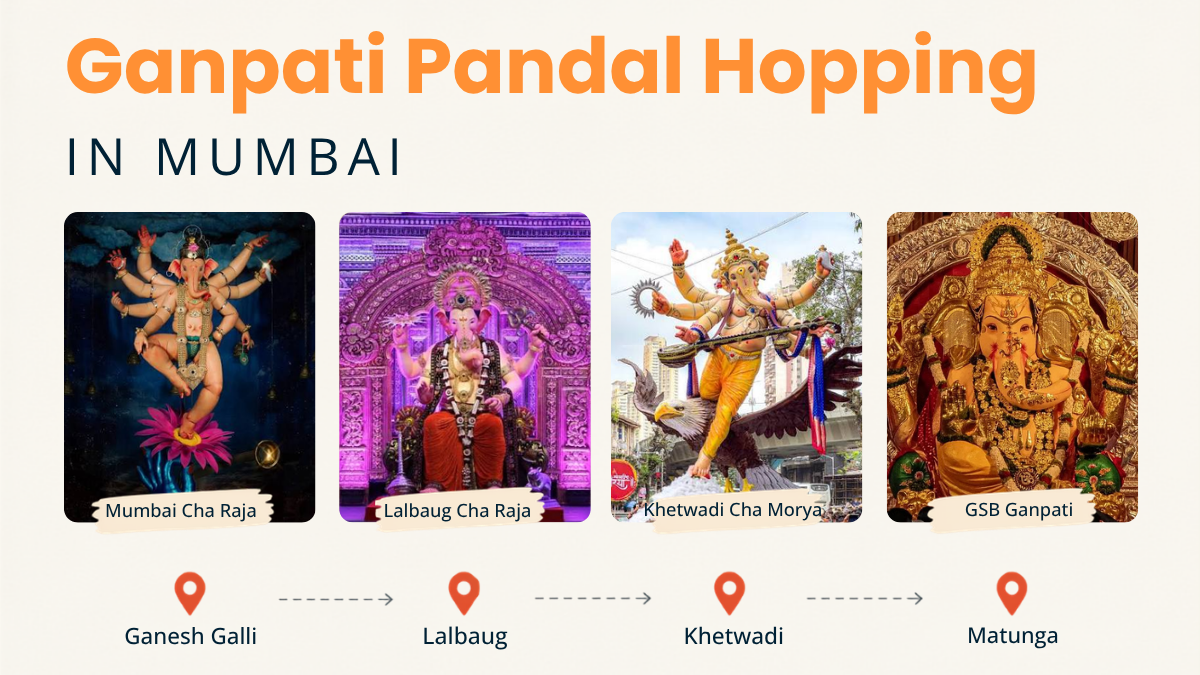
GANPATI PANDAL HOPPING IN MUMBAI BY TRAIN
The Yatri Guide to Planning Your Darshan
Ganesh Chaturthi 2026
14 September – 25 September 2026
Ganpati Bappa Morya🙏
Mumbai during Ganesh Chaturthi is not just a festival—it is a city-wide experience.
From the grand celebrations at Lalbaug to the traditional atmosphere of Girgaon and Matunga, thousands of devotees travel across Mumbai every day for darshan.
And while visiting multiple Ganpati pandals sounds simple, getting between them during Ganeshotsav requires a little planning.
Traffic changes. Roads get crowded. Railway stations become busy. A route that works perfectly in the morning may not be the best option in the evening.
That's why pandal hopping in Mumbai is less about finding one perfect route and more about planning your entire journey around timing, crowds, public transport and walking.
With Yatri, you can plan your journey using Mumbai's local trains, Metro, BEST buses and other public-transport options—helping you decide not only how to reach your first pandal, but also how to move between pandals and return home.
GANESH CHATURTHI 2026: PLAN BEFORE YOU TRAVEL
Ganesh Chaturthi will be celebrated on 14 September 2026, with Anant Chaturdashi on 25 September 2026.
If you're planning pandal hopping, remember that crowd levels can vary significantly depending on the day and time. Popular pandals are generally busier during evenings, weekends and the final days of the festival.
The simple rule: Don't plan your pandal-hopping route only by distance. Plan it by:
TIME + TRANSPORT + WALKING + DARSHAN QUEUE
QUICK ANSWER
• Best strategy: Start early or plan your visits around less-crowded time windows.
• Best for long-distance travellers: Use Mumbai local trains for the longer part of your journey and plan the last mile separately.
• Best for families: Look for routes with fewer interchanges and shorter walking distances.
• Best for multiple pandals: Group nearby pandals together instead of crossing the city repeatedly.
• Best return strategy: Plan your return journey before beginning your last darshan.
• Best Yatri habit: Check your journey again before every leg because festival traffic and transport conditions can change.
THE SMART WAY TO PLAN GANPATI PANDAL HOPPING
A typical pandal-hopping journey has four parts:
HOME → PUBLIC TRANSPORT → LAST-MILE WALK → DARSHAN
Then the same process happens in reverse.
The mistake many visitors make is planning only the first part. You may find a fast local train to Lalbaug, but if the station exit is crowded or your walking route is affected by barricades, your actual journey can take much longer.
Before leaving, check:
• Your route from home • Available local trains • Metro connections • BEST bus options • Interchanges • Walking distance • Your return journey
DIFFERENT PANDAL-HOPPING PLANS NEED DIFFERENT STRATEGIES
THE FIRST-TIME VISITOR
The challenge: You want to experience Mumbai's famous Ganpati celebrations but don't know how many pandals you can realistically cover.
Best strategy: Start with 3–4 major pandals and group them geographically.
A practical route: Lalbaugcha Raja → Ganesh Galli → Khetwadi → Matunga
Yatri Tip: Enter your next destination into Yatri after finishing each pandal. The best option for your next journey may be different from the route you used earlier in the day.
THE LONG-DISTANCE DEVOTEE
If you're travelling from areas such as Virar, Borivali, Thane, Dombivli or Navi Mumbai, the journey itself can take a significant part of your day.
Best strategy: Start early and use the local train for the long-distance portion.
Example: HOME → WESTERN/CENTRAL/HARBOUR LINE → INTERCHANGE → LALBAUG AREA → WALK → DARSHAN
Yatri Tip: Check live train information before leaving. If your preferred connection is delayed, look for an alternative route.
THE FAMILY PANDAL-HOPPING GROUP
Travelling with children or elderly family members changes the equation.
Best strategy - Prioritise: Fewer interchanges • Manageable walking distances • Convenient public transport • Easy return options
Yatri Tip: Consider the number of transfers and the final walking portion too, not just travel time.
THE SOLO DEVOTEE
Travelling alone gives you more flexibility.
Best strategy: LOCAL TRAIN → WALK → PANDAL → WALK/BUS → NEXT PANDAL → METRO/LOCAL TRAIN → HOME
Yatri Tip: Check your next destination immediately after darshan. Walking or a bus may be more convenient than returning to the railway station.
THE WORKING PROFESSIONAL
For many Mumbaikars, pandal hopping happens after work.
Best strategy: Plan backwards. First decide: What time do I want to finish darshan?
Then work backwards: DARSHAN → QUEUE → ARRIVAL → TRAVEL → DEPARTURE FROM WORK
Yatri Tip: Check your return journey before starting darshan. This helps you decide how late you can comfortably stay.
THE BEST GANPATI PANDAL ROUTE IS A CLUSTER, NOT A MAP
One of the biggest mistakes in pandal hopping is trying to visit famous pandals based purely on popularity. Instead, think geographically.
CLUSTER 1: LALBAUG - Lalbaugcha Raja → Ganesh Galli
These two celebrations can be planned together because they are located in the same broader area.
CLUSTER 2: GIRGAON - Khetwadi
This gives you a different side of Mumbai's Ganeshotsav experience without immediately crossing the city again.
CLUSTER 3: MATUNGA - GSB Seva Mandal
This creates a natural progression from central Mumbai towards the Matunga side.
SAMPLE ROUTE: HOME → LALBAUGCHA RAJA → GANESH GALLI → KHETWADI → GSB SEVA MANDAL → HOME
Yatri Tip: Don't treat this as a fixed route. Use it as a framework and let Yatri help you decide the most practical connection between each stop.
LOCAL TRAINS: THE BACKBONE OF MUMBAI'S PANDAL-HOPPING JOURNEY
Mumbai's local railway network is one of the most useful ways to cover longer distances during Ganeshotsav.
For Lalbaug and nearby areas, consider stations such as: Currey Road • Chinchpokli • Parel • Byculla
Your decision should consider:
• Which railway line you're already travelling on • Number of interchanges • Current train conditions • Walking distance • Crowd movement around the station • Your final destination
THE YATRI APPROACH
Instead of asking: "Which station is closest?"
Ask: "Which complete journey is easiest from where I am right now?"
That's the difference between station-based planning and journey-based planning.
A PRACTICAL ONE-DAY PANDAL-HOPPING PLAN
|
Time |
Plan |
|
Morning |
Start your journey |
|
8:00–9:00 AM |
Reach the Lalbaug area |
|
Morning |
Lalbaugcha Raja |
|
Late morning |
Ganesh Galli |
|
Afternoon |
Lunch and travel towards Girgaon |
|
Afternoon |
Khetwadi Ganpati |
|
Evening |
Travel towards Matunga |
|
Evening |
GSB Seva Mandal |
|
Night |
Begin return journey |
Important: Treat this as a planning framework, not a fixed timetable. Darshan queues, transport conditions, walking time and crowd-management arrangements can change during the festival.
FREQUENTLY ASKED QUESTIONS
Which railway station is best for Lalbaugcha Raja?
Currey Road and Chinchpokli are commonly considered railway options. The best option depends on your complete journey, not simply the station's distance from the pandal.
Can I visit multiple Ganpati pandals in one day?
Yes. Group nearby pandals together. A practical route: Lalbaugcha Raja → Ganesh Galli → Khetwadi → GSB Seva Mandal. Allow enough time for travel, walking and darshan queues.
Should I use a local train or bus for pandal hopping?
Local trains are useful for longer distances, while BEST buses can be convenient for shorter connections and last-mile travel. Use Yatri to compare available options.
Can Metro be part of my pandal-hopping route?
Yes. Metro can work well as one part of a multimodal journey. Combine Metro with local trains, buses and walking.
What is the best time for Ganpati pandal hopping?
Early morning can help avoid heavier crowds. Evening visits offer a lively atmosphere but may involve longer queues. Your ideal timing depends on the pandal, day of festival and crowd conditions.
YOUR YATRI GANPATI FORMULA
✓ PLAN BEFORE LEAVING
✓ CHECK LIVE TRANSPORT BEFORE BOARDING
✓ THINK ABOUT THE LAST MILE
✓ GROUP NEARBY PANDALS
✓ RECHECK YOUR ROUTE BETWEEN VISITS
✓ PLAN YOUR RETURN BEFORE THE LAST DARSHAN
Because during Ganeshotsav, the smartest route isn't always the shortest one. It's the route that gets you there with less stress and more time to experience Mumbai's Ganpati celebrations.
Dated September 17, 2026