
How Yatri Became Mumbai's Official Local Train App
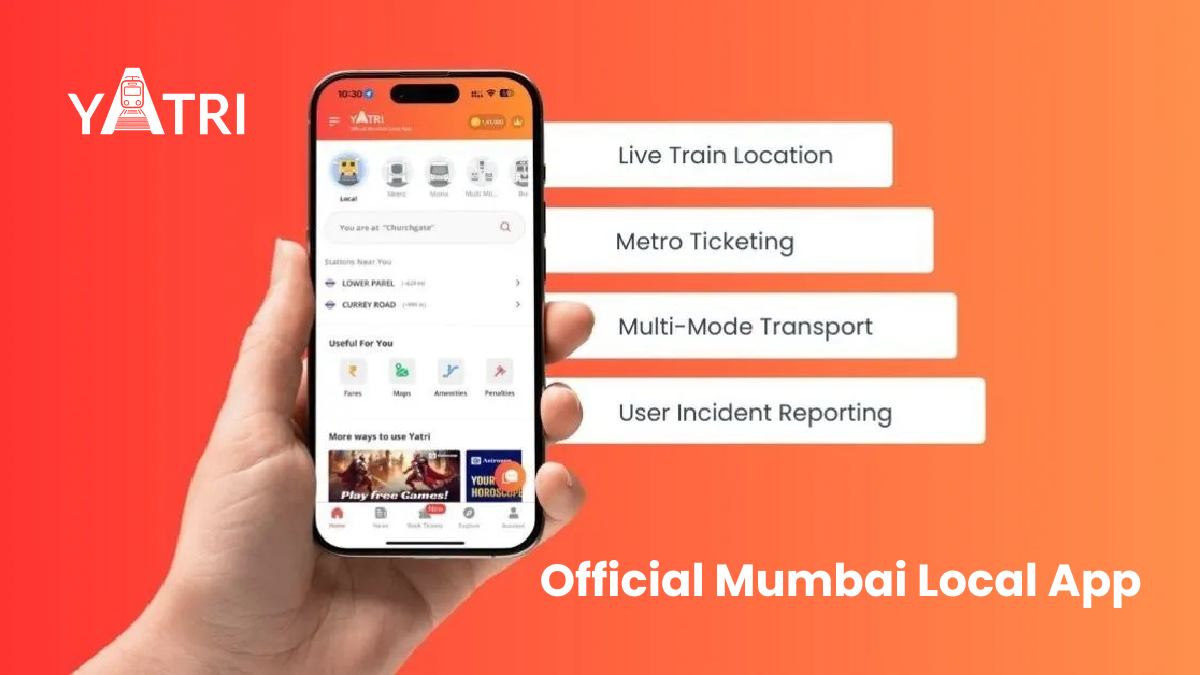
If you've ever stood at a Mumbai local platform, squinting down the tracks as a distant headlight approaches, trying to telepathically understand whether you’ll be able to catch that train or not; you’ll understand the problem Yatri was born to solve. No live tracking. No reliable alerts. Just 8 million commuters doing the same guesswork, every single day.
That frustration had a name and a solution and it came from two sisters who grew up in this city and were tired of the chaos themselves.
Reeva Sakaria and Lakhi Sakaria Chowdhary are the co-founders of Yatri, now the official app of Mumbai's local train network and an official partner of Indian Railways, working across both the Central and Western Railway divisions. What started as a bootstrapped idea in April 2021 became a live product in July 2022 and has since clocked over 2.1 million downloads.
“If you've lived in Mumbai long enough, you've known there should be something like this.”
— Reeva Sakaria, Co-founder, Yatri
But the journey from idea to official partnership was anything but straightforward. It involved custom-built hardware, months of failed prototypes, machine learning layered on top of physical GPS devices, and a deep, ground-level understanding of how Mumbai's trains actually move.
A Family Legacy, a City-Scale Problem
The Yatri story begins with a 34-year-old family organization, as YourStory reported, the app emerged from the software division of CDP India Pvt Ltd, the sisters' family-run company with decades of enterprise technology experience behind it. That institutional depth, the kind that only comes from building software for over three decades gave the team something most consumer startups lack: patience for problems that take time to solve right.
And the Yatri problem needed exactly that. The near-total absence of real-time, reliable information was the founding wound. Not just a minor inconvenience but a systemic gap affecting millions of people who depend on the local network for their livelihoods, their families, their entire daily rhythm./english-betterindia/media/media_files/2026/04/01/yatri-2-2026-04-01-18-36-52.jpg)
Reeva Sakaria & Lakhi Sakaria
The GPS Challenge Nobody Had Cracked
The technical challenge at the heart of Yatri wasn't building an app. It was building the infrastructure that makes the app worth opening.
Lakhi, who holds a BTech in Information Technology and is an IIM Ahmedabad alumnus, explains that Mumbai's local network presented a unique hardware problem.
As The Better India documented, the network runs both older rolling stock and modern AC locals, meaning any device had to work across wildly different manufacturing generations. That alone required multiple prototypes, each one field-tested for three to four weeks at a time on live trains before being refined and rebuilt.
“One of the biggest challenges we took on was something no one had really managed to do successfully before: installing a GPS device in Mumbai’s local trains. Over 3,000 trains are running every day, so the scale itself is massive. That’s what made the technology complicated, but also exciting and challenging for us to work on.”
— Lakhi Sakaria Chowdhary, Co-founder, Yatri
Early attempts included a card-machine-style device but that approach was quickly abandoned. Motormen, the team realised, already carry an enormous operational burden. Asking them to manage yet another device was simply impractical. The sisters went back to the drawing board.
The eventual solution was elegant: Bluetooth sensors installed at key stations, paired with proprietary GPS devices engineered to run on DC (direct current), the very type of electricity that powers Mumbai's local trains. These aren't off-the-shelf components. Every part of the system was custom-built.
SOURCE-VERIFIED, NOT CROWDSOURCED
This is the detail that sets Yatri apart from anything else in the market. The GPS data is fed directly from railway control rooms and not aggregated from user reports or third-party feeds. When there's a mega block, a platform change, or a service disruption, the alert hits Yatri users the moment it hits the railway's own system. That's a fundamentally different promise than what other apps offer..png)
Testing It the Hard Way
Once the hardware was ready, the software still had to earn its accuracy. Algorithms and machine learning could only go so far but the real test was on the ground. The Yatri team deployed people inside trains throughout the day, while others tracked the corresponding GPS signals from outside. Every second of delay was a problem. Every discrepancy was a bug to hunt.
There was also the challenge of train identity itself. Each Mumbai local is identified by a rake number but those rakes constantly move between lines, car sheds, and routes. A single train might start its day on one corridor and appear somewhere completely different by afternoon. Yatri's system had to account for all of those edge cases, using AI and machine learning layered on top of the hardware to keep the live tracking honest.
WHAT YATRI OFFERS TODAY
A complete rundown of the app's core features:
→ Live GPS train tracking on Central and Western Railway lines, sourced directly from control rooms
→ Real-time alerts for delays, platform changes, cancellations, and service disruptions
→ Voice recognition to speak source and destination station names
→ Geo-location to find the nearest station, with personalised route notifications
→ Multi-modal journey planning across Local Trains, Metro, BEST Buses, Ferry, and Monorail in one search
→ Metro ticketing, with plans to expand to buses and local trains
→ Available in English, Hindi, and Marathi; accessible offline
/filters:format(webp)/english-betterindia/media/media_files/2026/04/01/yatri-1-2026-04-01-18-34-18.jpg)
Features of Yatri App
Beyond Trains: The Multi-Modal Vision
Mumbai's transport reality is not one network but rather a patchwork. Most commuters stitch together a local train leg with a bus, an auto-rickshaw, a metro section, and occasionally a ferry. No single previous app respected that complexity.
Yatri's multi-modal feature does. Enter your start and end points, and the app returns route combinations across local trains, metro lines, BEST buses, and more. Building that required the team to establish direct data relationships with metro control rooms, the BEST bus authority, ferry operators, and others with not just technical integrations, but operational ones.
The next milestone is ticketing. Metro ticketing is already live within the app. Over the next year, the founders aim to extend that to buses and local trains making Yatri a complete journey-planning and booking platform for public transport, not just a tracking tool..png)
A Hometown App with National Ambitions
What makes Yatri particularly meaningful is where it was built and by whom. This is a Mumbai product, made by Mumbaikars, for a commuter base that has waited decades for this kind of clarity. The app is available in English, Hindi, and Marathi, reflecting the linguistic reality of its users.
While it began with Mumbai's local trains, Yatri has since expanded to cover Pune, Kochi, Bengaluru, Delhi, and Kanpur suggesting that the platform's real ambition is to become India's trusted public transport companion, city by city.
The sisters' family background in enterprise software gave them an unusual edge: the discipline to solve a hard infrastructure problem before worrying about user acquisition. The 2.1 million downloads didn't come from a marketing blitz. They came from commuters who finally got a straight answer to a question they'd been asking for years.
“We wanted to build the one official digital information centre for railways and that's what Yatri is.”
— Reeva Sakaria, Co-founder, Yatri
What Comes Next
The road ahead for Yatri involves two parallel tracks. The first is deepening what already exists that is making GPS coverage more precise, expanding multi-modal data partnerships, and perfecting the ticketing experience. The second is geographic expansion, bringing the same source-verified reliability to commuters in more Indian cities.
Mumbai's transport ecosystem itself keeps shifting like new metro lines being introduces, route revisions, infrastructure upgrades. Every change is an update Yatri has to absorb and reflect in real time. That's not a burden the team shies away from. It's the job.
For a city that runs on its trains, where missing one train can unravel an entire day, Yatri isn't just a convenience. It's infrastructure. And it was built, quietly and stubbornly, by two sisters who simply refused to accept that no one had done it properly yet.
READ MORE:
The Better India: This Sister Duo's App Helps You Track Your Train on Mumbai's Busy Local Network: https://thebetterindia.com/innovation/yatri-app-mumbai-locals-train-commute-public-transport-live-location-11443615
YourStory: Mumbai's Local Train App Yatri: https://yourstory.com/2026/04/mumbai-local-train-app-yatri-sourcing-talent-beyond-bengaluru
Dated May 7, 2026