
Mumbai to Lonavala Train 2026 Best Time to Visit, Monsoon Guide & Everything a Mumbaikar Needs to Know
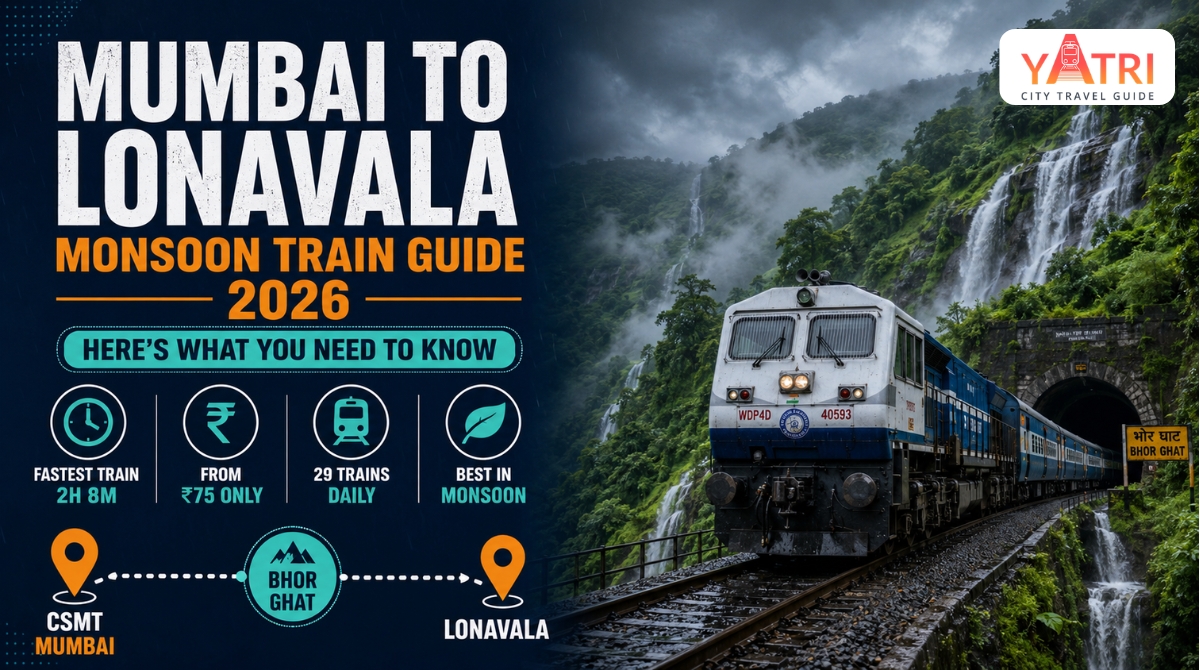
The Mumbai to Lonavala train journey is one of those trips every Mumbaikar takes at least once and then from then on keeps taking. No luxury planning needed. Just a local train, a window seat, cutting chai, and the quiet satisfaction of watching Mumbai's chaos slowly disappear behind fog-covered hills. Whether you're looking for the best time to visit Lonavala, planning your first monsoon trip, or figuring out which train to catch from Mumbai. This is your complete 2026 guide to the easiest weekend escape from the city.
There’s a very specific kind of madness that hits a Mumbaikar the moment the first rains arrive. You’re standing at Dadar station, soaked despite your umbrella (which is now inside out), your shoes making sounds that could be mistaken for a whale call, and somewhere in the back of your head a very persistent voice goes: “Yaar, Lonavala jaana chahiye.”
And you know what? That voice is right. It’s always right. Lonavala is Mumbai’s official “reset button.” Every year, the moment the Western Ghats turn green and the waterfalls decide to wake up from their nine-month nap, thousands of Mumbaikars collectively abandon all productivity and board a train. This blog is for all of you the planners, the last-minute people, the “challo villa jaate hai” types, and the ones reading this on their phone while already at the station.
First, Let’s Talk About Which Mumbai Rail Line Are You:
Before we even get to trains and timings, there’s a cultural prerequisite: Mumbai runs on three rail lines: Western, Central, and Harbour. Each one has a distinct personality.
P.S: you know your line better than your own extended family.
|
Western Line Always in a rush, somehow always at the wrong end of the platform. Has unreasonable opinions about which bogie is ‘less crowded.’ Will plan a Lonavala trip and cancel it twice before finally going. |
Central Line Battle-hardened. Has survived Kurla Junction. Talks to strangers on trains. Probably knows the exact seat number they want on the Deccan Express. Will eat vada pav on the train without spilling a single crumb. A legend. |
Harbour Line Underestimated, chronically overlooked, but surprisingly chill. Takes the long route and somehow arrives before everyone else. The friend who quietly books tickets three weeks in advance and sends you the PNR at 6 AM. |
Here’s the thing: when it comes to Lonavala, everyone converges on Central Railway. The Western Line and Harbour Line loyalists must surrender their identity for a day and board from CSMT. There’s a humility in this. It’s beautiful, really!
The Trains: A Real Guide (With Actual Train Numbers)
There are close to 29 trains running between Mumbai CSMT and Lonavala on any given day, covering roughly 95 to 120 km depending on origin. Here are the ones that actually matter for your trip:
1. 22105 Indrayani Superfast Express: The Early Bird Special
|
Departs: 5:40 AM CSMT |
Arrives LNL: 7:58 AM |
Fare from: ₹90 (2s) | ₹340+ (AC Chair Car) |
Runs: Daily |
Named after the river Indrayani that flows through Pune district, this train has been running since 1988 and was upgraded to LHB coaches in 2020. Departing at 5:40 AM means you’re in Lonavala before 8 and have the entire Sahyadri range mostly to yourself before the Sunday crowds roll in. This is the one for the serious Lonavala crowd; trekkers, photographers trying to catch Kune Falls at golden hour, couples who planned this two weeks ago.
Fun fact: The Indrayani Express is named after a culturally significant river running right through Pune district the same river, same name, still running on time (mostly).
2. 12127 Mumbai CSMT–Pune Intercity Superfast Express: The Sensible Choice
|
Departs: 6:40 AM CSMT |
Arrives LNL: 8:48 AM |
Fare from: ₹90 (2S) |
Runs: Daily |
The slightly more reasonable option for people who consider 5:40 AM an act of violence. Equally fast, equally reliable, and gets you to Lonavala in time for a proper breakfast with fog still hanging over the valleys. This is the “I’m a morning person, but on my own terms” train.
Fun fact: This train runs the same CSMT to Pune corridor as the Indrayani and is just as fast as the extra hour of sleep is the only real difference between the two.
3. 11007 Deccan Express: The People’s Train
|
Departs: 7:00 AM CSMT |
Arrives LNL: 9:38 AM |
Fare from: ₹75 (2S) | ₹265 (CC) |
Runs: Daily |
The Deccan Express is the train equivalent of a well-worn leather chappal, unglamorous, absolutely reliable, and beloved by everyone who uses it. At ₹75 for second sitting, this is currently one of the cheapest reserved seats on this route. If your budget is tighter than Mumbai’s peak-hour footpath, this is your train.
Fun fact: The Deccan Express (11007) holds the record for being one of the most consistently full trains on this route every single weekend. If you’re going on a Saturday or Sunday, book at least a week ahead.
4. 12123 Deccan Queen: The Icon
|
Departs: 5:10 PM CSMT |
Arrives LNL: 7:18 PM |
Fare from: ₹340+ (CC) | ₹700–800 (Vistadome) |
Runs: Daily |
Now we’re talking royalty. The Deccan Queen or “Dakkhan ki Rani” which has just turned 96 years old in June 2026. Let that sink in. This train has been running since June 1, 1930. She was India’s first deluxe train, the first long-distance electric-hauled passenger train, the first train to have a women-only car, and the first to feature a dining car with actual table service. She has been running longer than most of our grandparents have been alive. Book the Vistadome coach and watch the Western Ghats disappear into the fog at dusk.
Fun fact: Central Railway’s own description of the Deccan Queen in June 2026: “Still slaying like a queen.” She’s 96. Unbothered. Iconic.
5. 12125 Pragati Express: The Fastest
|
Departs: 5:30 PM Panvel |
Arrives LNL: 6:46 PM LNL |
Fare from: ₹340+ (CC) |
Runs: Select days |
At 1 hour 16 minutes, the fastest train to Lonavala on record. The catch: it departs from Panvel, not CSMT. If you’re based in Navi Mumbai or Panvel side, this is genuinely excellent and worth the effort.
Fun fact: Pragati means ‘progress’ in Hindi. At 1 hour 16 minutes to Lonavala, it’s living up to the name.
Quick Reference: All Key Trains at a Glance
Fares are indicative as of 2026. Always verify on IRCTC before booking.
|
Train |
Departs (CSMT) |
Arrives LNL |
Duration |
Min. Fare |
|
22105 Indrayani SF Exp |
5:40 AM |
7:58 AM |
2h 18m |
₹90 (2S) |
|
12127 Intercity SF Exp |
6:40 AM |
8:48 AM |
2h 8m |
₹90 (2S) |
|
11007 Deccan Express |
7:00 AM |
9:38 AM |
2h 38m |
₹75 (2S) |
|
11301 Udyan Express |
8:10 AM |
10:33 AM |
2h 23m |
₹145 (SL) |
|
11029 Koyna Express |
8:40 AM |
11:08 AM |
2h 28m |
₹145 (SL) |
|
12123 Deccan Queen |
5:10 PM |
7:18 PM |
2h 08m |
₹340+ (CC) |
|
11009 Sinhagad Express |
5:50 PM |
8:18 PM |
2h 28m |
₹75 (2S) |
.png)
The Monsoon Guide: When to Go, What to Expect:
Let’s be real about Lonavala in the monsoon: it will be wet, it will be crowded on weekends, your phone will fog up the moment you step off the train, and it will be one of the best things you do all year. Here’s how to time it right.
1. June - The Opener:
The rains arrive and Lonavala shakes off nine months of dryness like a dog shaking off bathwater. Everything turns green almost overnight. This is the ‘before the crowds discover it’ window.
Tip: Go in the second half of June if you want greenery without the Bhushi Dam stampede.
2. July & August - Peak Monsoon Glory (Also Peak Chaos):
Lonavala at full power. Kune Falls 200 metres, cascading in three tiers is roaring. Tiger’s Point is wrapped in mist. Bhushi Dam’s stone steps disappear under rushing water and the entire city of Mumbai shows up to stand on them. Rajmachi Fort trek turns into a proper adventure. July and August have the best views. They also have the most people.
Tip: If going on a weekend in July or August, leave Mumbai by 7 AM at the absolute latest. Book tickets at least a week in advance.
3. September - The Secret Recommendation:
The rains are easing but the landscape is still deeply green. Waterfalls are still running. Crowds thin out significantly. You can actually stand at Tiger’s Leap and take a photo without seventeen strangers photobombing it. September Lonavala is genuinely underrated.
Tip: This is the sweet spot: full greenery, less crowd, same waterfalls. Weekdays in September are as close to Lonavala paradise as you can get.
4. Oct to Feb - Post-Monsoon Clarity:
Skies clear up completely. Trekking season is at its best Rajmachi, Lohagad, the Karla and Bhaja Caves. Cooler temperatures (12–29°C). Great for families. Less dramatic, but peaceful and beautiful in a quieter way.
Tip: Best season for Rajmachi and Lohagad Fort treks. Book accommodation in advance for Diwali and Christmas weekends.
Where to Go Once You’re There?
These are the spots worth your time roughly in order of monsoon impact:
1. Bhushi Dam
The unofficial headquarters of monsoon Lonavala. Water rushes over stone steps and everyone queues up to stand in it. Go early by 10 AM it's already shoulder-to-shoulder.
2. Kune Falls
Three-tiered cascade, 200 metres high, surrounded by forest. One of the most visually stunning falls in Maharashtra during peak monsoon. Worth the trek.
3. Tiger's Leap
A cliff jutting out over the valley at 650 metres. The mist makes the whole valley disappear beneath you. Named after the rock formation that looks like a leaping tiger.
4. Rajmachi Fort
For the trekkers. Dense forest trails, streams to cross, waterfalls along the route, and an actual fort with Sahyadri views at the top. Kataldhar Waterfall en route is a hidden gem.
4. Lohagad Fort
More accessible than Rajmachi, with sweeping views of Pawna Lake from the battlements. Brilliant in October once the rains ease.
5. Pawna Lake
Evening camping spot. Bonfires, tents, lake views, and the kind of quiet that makes you forget Mumbai exists.
.png)
A Few Things Nobody Tells You (But We Will):
- The train journey itself is the experience. Once the train climbs into the Ghats after Karjat, the scenery through the window becomes genuinely incredible. Tunnels, viaducts, dense forest, waterfalls right next to the tracks. The Bhor Ghat section which the Deccan Queen has been climbing since 1930 is one of the most scenic rail stretches in India. Don’t sleep through it.
- Book tickets at least a week in advance for July and August weekends. The Indrayani, Intercity, and Deccan Queen fill up fast. Tatkal opens 24 hours before departure if you’re in a pinch, but prices jump.
- Weekdays are significantly better than weekends. This applies to trains, to Bhushi Dam, to parking, and to general human sanity.
- Carry a proper raincoat, not an umbrella. The winds in the Ghats will invert your umbrella with zero remorse. A poncho or waterproof jacket is the move.
- Your phone will fog up. The temperature difference between the train and the outdoors in monsoon Lonavala is real. Give it a minute.
Final Thoughts:
There’s a reason this exact trip Mumbai to Lonavala, Central Railway, monsoon has been repeated by Mumbaikars for nearly a hundred years. The Deccan Queen was doing this route when your grandparents were children. The Indrayani Express has been at this for nearly four decades. Something about leaving behind the city heat and concrete and arriving into green mist and roaring waterfalls is irreplaceable and the train is the only honest way to do it.
The road gets jammed. The expressway becomes a parking lot by 9 AM on rainy Sundays. But the train leaves at 5:40 AM, climbs through the Bhor Ghat, and deposits you in Lonavala with two hours of morning left to explore before the crowds arrive.
That window between when you step off the train and when the rest of Mumbai shows up is worth every early alarm.
Download The Yatri App Now!
FAQs:
1. What is the Mumbai to Lonavala train ticket price in 2026?
The train fare varies depending on the train type and the class of travel. As of 2026, the cheapest option is the Second Seating (2S) class, which starts at just ₹80 to ₹90. For more comfort, Sleeper (SL) class tickets cost around ₹150. If you prefer air-conditioned travel, AC 3-Tier (3A) tickets are priced at approximately ₹520, AC 2-Tier (2A) around ₹725, and First Class AC (1A) ranges from ₹1,190 to ₹1,270.
2. Which is the best train from Mumbai to Lonavala in 2026?
The best train depends on your timing. For the earliest arrival, the 22105 Indrayani Superfast Express departs CSMT at 5:40 AM and reaches Lonavala by 7:58 AM ideal for trekkers and photographers. For a balance of timing and comfort, the 12127 Mumbai–Pune Intercity Superfast Express at 6:40 AM is the sweet spot. For the most affordable ticket, the 11007 Deccan Express at 7:00 AM starts from ₹75 in second sitting. For the iconic experience, the 12123 Deccan Queen departs at 5:10 PM and includes a Vistadome coach with panoramic Western Ghats views. Around 20 trains run daily on this route, but these four cover every type of Mumbaikar.
3. What is the best time to visit Lonavala from Mumbai?
The best time to visit Lonavala is June to September during the monsoon months, when the Sahyadri hills turn deep green, Kune Falls runs at full 200-metre height, and the entire landscape transforms. However, within monsoon, September is the hidden gem greenery is fully intact, waterfalls are still flowing, and crowds thin out significantly compared to July and August. Winter (October to February) offers pleasant temperatures between 12–29°C and is best for trekking, camping, and visiting Rajmachi and Lohagad forts. Summer (March to May) is the least recommended waterfalls disappear and the heat reduces the magic considerably.
4. How much time does it take to travel from Mumbai to Lonavala by train?
The train journey from Mumbai to Lonavala is a quick and scenic ride, generally taking between 2 hours and 2.5 hours. The total rail distance is approximately 115 to 121 km. The exact travel time depends on your boarding station and the specific train you choose. Fast trains like the Pragati Express and Deccan Queen can complete the journey in close to 2 hours.
Dated June 11, 2026