
International Women’s Day 2026: Theme, History, Significance and Global Campaign
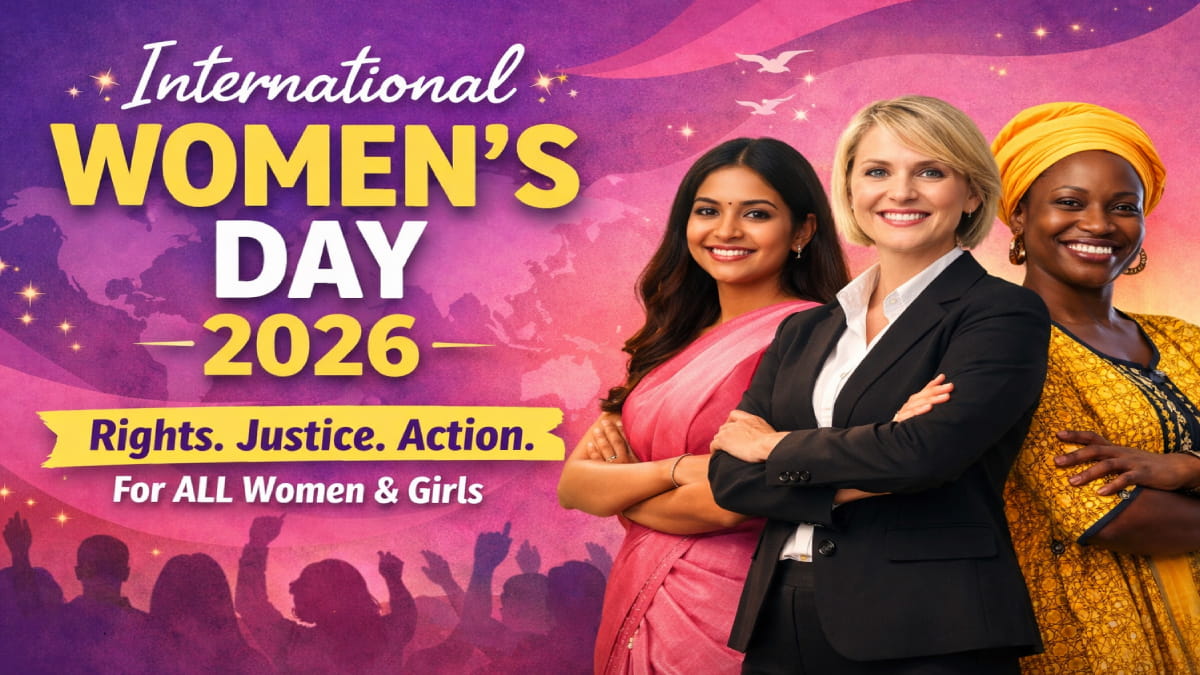
Every year on 8 March, the world observes International Women’s Day, a global occasion dedicated to celebrating women’s achievements and advancing the movement for gender equality.
In 2026, the theme for International Women’s Day is:
“Rights. Justice. Action. For ALL Women and Girls.”
The theme highlights the urgent need to strengthen women’s rights, improve access to justice and accelerate meaningful action toward equality for women and girls across the world.
More than a symbolic celebration, International Women’s Day serves as a reminder of the long journey towards gender equality and the work that still lies ahead.
Why International Women’s Day is Observed on 8 March
The origins of International Women’s Day trace back to the early twentieth century, when women’s movements in North America and Europe began demanding better working conditions, fair wages and voting rights.
One of the most significant events took place in 1917, when women in Russia went on strike demanding “bread and peace.” The protest began on 23 February according to the Julian calendar, which corresponds to 8 March in the Gregorian calendar used today.
Over time, the date became globally associated with the struggle for women’s rights. In 1977, the United Nations officially recognised International Women’s Day, giving global institutional recognition to a movement that had already been shaping societies for decades.
Today, 8 March is observed worldwide as a day to honour women’s contributions to social, economic, cultural and political progress.
.png)
The Theme of International Women’s Day 2026
The United Nations U.N. theme for International Women’s Day 2026 is:
“Rights. Justice. Action. For ALL Women and Girls.”
This theme emphasises three key priorities:
1. Strengthening Women’s Rights
Ensuring that women and girls everywhere enjoy equal rights in education, employment, healthcare and public life.
2. Access to Justice
Promoting legal systems and policies that protect women from discrimination, violence and inequality.
3. Accelerating Action
Encouraging governments, organisations and communities to move beyond symbolic gestures and take real steps toward gender equality.
Across the world, events, discussions and awareness campaigns will highlight policies and initiatives aimed at empowering women and promoting inclusive development.
The Global “Give to Gain” Campaign
Alongside the theme, International Women’s Day 2026 is also marked by the global campaign “Give to Gain.”
This initiative highlights the importance of collaboration and generosity in advancing gender equality.
The campaign encourages individuals, organisations and institutions to contribute by:
- Mentoring women and girls
- Providing educational opportunities
- Supporting women entrepreneurs
- Investing time and resources into community initiatives
The idea behind “Give to Gain” is simple but powerful: when society invests in women’s growth and leadership, the benefits extend far beyond individuals.
Stronger participation by women leads to stronger families, communities and economies.
Women’s Rights Movements: A Story of Collective Action
The progress achieved in women’s rights did not happen overnight. Instead, it emerged through decades of collective action.
Across the world, women organised themselves in factories, community halls and public squares, demanding equality, dignity and opportunity.
From labour rights movements to suffrage campaigns that secured women the right to vote, these efforts reshaped political systems and social institutions.
Over time, global conventions, international organisations and national governments adopted policies promoting gender equality.
International Women’s Day today reflects both this historic struggle and the continued pursuit of fairness and inclusion.
Women’s Empowerment in India
India’s approach to women’s empowerment has evolved significantly over time.
Earlier policies often focused on development for women, but the national development framework now emphasises women-led development, recognising women as key drivers of economic and social progress.
This shift reflects a growing understanding that empowering women strengthens society as a whole.
Constitutional Guarantees
The Constitution of India guarantees equality before the law and ensures universal adult franchise, enabling women to participate equally in the democratic process.
These constitutional protections form the foundation of women’s rights in the country.
Women’s Economic Participation
A key pillar of empowerment is economic independence.
Across India, initiatives supporting Self-Help Groups (SHGs), entrepreneurship and skill development are enabling women to build sustainable livelihoods.
These programmes help women:
- Start small businesses
- Access credit and financial support
- Develop vocational and technical skills
- Participate actively in local economies
Women entrepreneurs and community leaders are increasingly shaping India’s development story.
Celebrating Women’s Achievements
International Women’s Day is also a celebration.
Across the world, organisations, universities, communities and governments organise events such as:
- Conferences and discussions
- Cultural programmes
- Awards recognising women leaders
- Educational campaigns promoting gender equality
These activities highlight the achievements of women in fields such as science, education, politics, business, sports and social activism.
Moving from Awareness to Action
The theme “Rights. Justice. Action. For ALL Women and Girls” calls for a shift from symbolic recognition to tangible progress.
Real change requires collective effort from policymakers, institutions, communities and individuals.
The “Give to Gain” campaign reminds us that empowering women is not just about fairness; it is also about building stronger, more resilient societies.
When women are supported to learn, lead and innovate, entire communities benefit.
.png)
Women, Mobility and Safer Travel
Access to safe and reliable public transport plays a crucial role in women’s participation in education, employment and public life. When women can travel confidently across cities, it expands opportunities for work, learning and independence.
Digital tools are also helping improve travel experiences. For instance, commuter apps like Yatri provide real-time train updates, route planning and travel information that can make daily commuting easier and more predictable.
As cities grow and public transport networks expand, technology-driven solutions will continue to play an important role in making urban mobility safer and more accessible for women.
Frequently Asked Questions about International Women’s Day 2026
1. When is International Women’s Day celebrated in 2026?
International Women’s Day is celebrated on 8 March 2026, as it is observed globally every year on March 8.
2. What is the theme of International Women’s Day 2026?
The theme for International Women’s Day 2026 is “Rights. Justice. Action. For ALL Women and Girls.”
3. Why is International Women’s Day observed on 8 March?
The date is linked to 1917, when women in Russia went on strike demanding “bread and peace.” The protest occurred on 23 February in the Julian calendar, which corresponds to 8 March in the Gregorian calendar used today.
4. When did the United Nations recognise International Women’s Day?
The United Nations officially recognised International Women’s Day in 1977, acknowledging the global movement for women’s rights and gender equality.
5. What is the “Give to Gain” campaign for Women’s Day 2026?
The “Give to Gain” campaign encourages individuals and organisations to support women through mentorship, opportunities and resources, helping advance gender equality.
Final Thoughts
International Women’s Day 2026 is not only a celebration of women’s achievements but also a reminder of the responsibility shared by societies worldwide to advance equality.
From early labour movements to modern global campaigns, the journey toward gender equality continues.
As the world marks 8 March 2026, the message remains clear:
Protect rights. Ensure justice. Take action - for all women and girls.
Dated March 7, 2026